... Mittens starts campaigning against activist judges? And how obscene an amount of money will he be able to raise to run ads about the evils of activist judges because those same judges decreed that he's allowed to do as much of that as he can?
... The Obamas are getting it on in the Lincoln bedroom? Ain't no sex like just-changed-the-shape-of-nation's-moral-and-financial-priorities sex.
... Republicans remember that the mandate was originally their idea? And suffer a stroke trying to figure out how to campaign on that without riling up the colonial cos-players they've so eagerly grabbed their ankles for the past three years?
... CNN acknowledges this? You know, just to clear the air.
... we find out how many uses of "fuck" will show up in Scalia's dissent? Over/under is 6.5.
Thursday, June 28, 2012

Tuesday, June 26, 2012
A Quick, Stupid Thought
How well do you think a baldly cynical presidential candidate could do if they changed their name to "America?" You know, the kind of person who thinks far enough in advance that he'd do it some time in his twenties (I went to school with such people--they exist). Think of the slogans:
"America 2012."
"Americans For America."
"Vote America!" (the brazen disregard for punctuation would probably generate enough Internet chatter to warrant a full media cycle of talk by pundits, who would then declare that America had just won the media cycle)
"Be pro-America."
"Don't be anti-America." (seriously, how would the opposing candidate attack--or even present a simple opposing view--without opening him/herself up to accusations of being "anti-America?")
"Help Defend America." (when the scandals hit).
Even someone who did it just prior to entering the race (basically advertising the cynicism in big, neon lights) would surely benefit a little from the confusion in the voting booth when people see "America" on the ballot. I'm not saying someone named "America" would have the election in the bag, but it's gotta strip off a few percentage points.
And given the escalation of cynical stunts the last few election cycles, I'm thinking this will be a logical step at some point.
Decision 2028: America (D) vs. America (R)
Monday, June 25, 2012
The Art of Fielding
"Literature could turn you into an asshole... it could teach you to treat real people the way you did characters, as instruments of your own intellectual pleasure, cadavers on which to practice your critical faculties."
Chad Harbach, The Art of Fielding
One of the reasons baseball works as a metaphor for life is that baseball contains long stretches of inactivity (some call it boredom), punctuated with brief, spectacular moments that are often tricky to explain. It's these latter moments that keep us coming back to the ballpark and carrying on through our day-to-day lives. This presents a problem, however, when trying to describe life in an entertaining way. Boredom is unforgivable in story-telling and inexplicable moments put the teller on a knife-edge; suspension of disbelief is one thing, but stray too far and people cry "deus ex machina." This is why the better baseball stories use the game as a device to set events in motion, without being the focus.
Chad Harbach successfully manages this balance through most of his debut novel, The Art of Fielding. It's appropriate that the team at the center of the action--the Westish College Harpooners--is made up of good-to-great players, most of whom will never play ball again after college; the diamonds they play on are little more than weigh stations. Fielding chooses to depict the feel of baseball rather than the game itself--mostly depicting the minutiae of the everyday lives of the students and faculty members at Westish.
Until the end of the book when, like any great ball game, some highly dramatic elements are needed to bring events to their close and, perhaps, give the audience something to remember. The problem is, as discussed earlier, this doesn't work as well in story-telling. The revelation of a character's death toward the end of a fraught, fast-paced game (which is described well but is, again, wrong for the medium--constant reminders of the score, outs, men on base, all necessary and part of the fun of the game, bog down the story) seems contrived for the sole purpose of amping up the drama and adding artificial weight to the ending. In most stories, this wouldn't be such a big deal, except Harbach had been doing very well 'till then.
For most of Fielding's 500+ pages, Harbach beautifully constructs not just the fictional Westish College, but its Herman Melville-centered mythology as well. He presents a series of characters--four third-person narrators rotating like a, well, if you know baseball I don't need to say it--that all fit so naturally at Westish it's hard to imagine them anywhere else. Most of them don't think of baseball much at all, except as the distraction it's always been meant to be. For a few others, baseball is one mildly significant aspect of their lives Only one, Henry Skrimshander, views the game as not even the defining aspect of himself, but as his whole life. This kind of obsession, naturally, lends itself to self-destruction, a fate that Harbach foreshadows early:
"After the game ended, you couldn't carry your game-time emotions out into the world--you'd be put in an asylum if you did--so you went underground and purged them."
The rules and temperaments of baseball don't apply outside the game. Mike Schwartz--who recruits Henry to Westish and someone for whom baseball is but one spinning plate--is a guy who understands this and though the demands he puts on himself are not without their own toll, his basic hardiness keeps him rolling on. Poor, unprepared Henry on the other hand is, for reasons not explored as thoroughly as they might be (at 500+ pages, something has to give), unable to grasp this. He functions in the non-baseball world well enough, but only because it's a bridge from game to game and season to season. Thus, when it's mysteriously taken from him, he collapses into himself, unable to recognize or want help. Then, when he's unexpectedly granted his dream of going pro, he opts to abandon it and to remain with at Westish, where all is familiar and his dream can be safely that. Henry's life is at its best when it's nothing but the long moments of inactivity punctuated by the vanishing sublime.
The trouble is, Henry takes a while to get there. As though running out of steam while rounding third, Harbach has trouble balancing the half-dozen subplots of Fielding. These subplots are all mostly good, but are clearly in need of one another, sometimes having trouble moving forward under their own power. When Henry disappears from his team and his friends, the suspense of where he's run off to is riveting, but I couldn't help but think that the mini-mystery was good only while it remained a mystery--that we'd find him and the answer would underwhelm. Sure enough, Henry's been off, being typically quiet Henry, minus the baseball. True to character, but a bit mundane. So it goes in the last third of Fielding. Each of the subplots enraptures at times, but drag at others.
That disappointment has much to do with the fact that Harbach does so well through the first half of Fielding. And without doing something inorganically (and laughably) explosive, the story was headed toward a kind of petering-out. These characters that aren't always likable--but are almost always relateable--will carry on afterward (minus one). There are no big revelations and no one has all the answers at the end. Some characters have excelled and are better people for their struggles while others will spend a bit longer in their respective ruts--smarter but with their brightest moments behind them. Not even Westish College athletics, having succeeded beyond anyone's most unrealistic hopes, can be sure what happens next.
But that's the ebb and flow of baseball. And isn't good baseball always more about the journey than the final score?
Grade: B
Thursday, June 21, 2012
Life In Hell
"Love is a snowmobile racing across the tundra
and then suddenly it flips over, trapping you underneath. At night, the
ice weasels come."
-- Matt Groening
Matt Groening ended his Life in Hell last week.
No, wait. Sorry. He ended his long-running comic strip Life in Hell last week. I never read a lot of the strip, outside of the stuff I found in the collected editions in the kind of bookstores that never would've sold LIH had its creator not also been the co-creator of The Simpsons. Indeed, if not for The Simpsons, I never would've known about it at all. I was raised too far away (in both time and space) from the epicenters of the alt-weeklies that provided an understanding home for Binky, Bongo, Sheba, and Akbar and Jeff. Even if I had been an adolescent/early-adult in the eighties in a town like Chicago or Seattle or L.A., I still probably wouldn't have been with-it enough to delve into them much. Unless perhaps I stumbled upon them in some dusty comic book shop. But who knows how long I would've stuck with them without a regular, pointed fix? It's only now, as the age of those physical stores passes, that huge numbers of us are able to absorb this kind of darkly incisive and borderline subversive work as easily as we do (time and space are not excuses anymore). And let us not forget how lucky we are for that.
That's the beauty of the Internet, satisfying niches with large enough demand to make them shine for a brief, effervescent moment but are so small as to be unappealing to the publishers and producers that ran an ancient media era (and tenuously cling to their control still) and would therefore have hardly existed. Life in Hell would go over just as well today as a web-comic as it did in the alt-weeklies 34 years ago. The Oatmeals and the XKCDs that owe no small credit to Groening's sensibilities and influences would be endlessly compared to LIH, sometimes positively, sometimes not. But LIH was accessible only to a few and at that time, that meant a kind of quality control you would never expect from mass-seen works, even if you sometimes got it. If James L. Brooks hadn't been living and working in L.A. in the eighties (though I'm not sure where else an acclaimed film producer would be living), he probably never would have seen LIH. In which case, he never would've called Groening in to pitch a TV show. And without that pitch, we never would have gotten LIH's greatest legacy: the institution to which modern television and Internet humor in general owe their greatest debts.
I have a lot to say about The Simpsons. No, really, a lot. That formless, word dump of a post about a hypothetical Justice League movie? That was nothing compared to what I could write about the show that partly raised me (the first Tracy Ullman shorts aired just months after I was born). There are very few topics you can throw at me that I can't somehow relate to one Simpsons moment or another. I've established close, long-lasting friendships on an initial foundation of Simpsons quote-fests. The Golden Age--that's seasons 4 through 8--still informs sizable chunks of my philosophies on politics, religion, morality, writing, comedy, pop culture, and loads of other things I probably don't even realize. And it's sad decline over the last decade-plus taught me the pitfalls of hero-worship and (along with the Cubs) how to love something while not letting that thing wholly define me, how to accept the imperfection of the things I love. That probably sounds sad to people who weren't raised on The Simpsons. And that's fine. I'm sure whatever icon they were raised on is almost as good as mine.
Those are thoughts better saved for their own post or posts. There will always be more time for a show that's primed to go for a few seasons more, making for a psychologically satisfying 25... and no end in sight. That's nine fewer than LIH had in its run. I suppose that's something to think about, when I complain about how long The Simpsons has stretched itself. But if I thought that the final episode of The Simpsons could buck the trend of the last ten seasons or so and be as true (and, therefore, poignant) to its original incarnation as the last edition of LIH was, then I probably wouldn't have a lot of reason to complain.
-- Matt Groening
Matt Groening ended his Life in Hell last week.
No, wait. Sorry. He ended his long-running comic strip Life in Hell last week. I never read a lot of the strip, outside of the stuff I found in the collected editions in the kind of bookstores that never would've sold LIH had its creator not also been the co-creator of The Simpsons. Indeed, if not for The Simpsons, I never would've known about it at all. I was raised too far away (in both time and space) from the epicenters of the alt-weeklies that provided an understanding home for Binky, Bongo, Sheba, and Akbar and Jeff. Even if I had been an adolescent/early-adult in the eighties in a town like Chicago or Seattle or L.A., I still probably wouldn't have been with-it enough to delve into them much. Unless perhaps I stumbled upon them in some dusty comic book shop. But who knows how long I would've stuck with them without a regular, pointed fix? It's only now, as the age of those physical stores passes, that huge numbers of us are able to absorb this kind of darkly incisive and borderline subversive work as easily as we do (time and space are not excuses anymore). And let us not forget how lucky we are for that.


That's the beauty of the Internet, satisfying niches with large enough demand to make them shine for a brief, effervescent moment but are so small as to be unappealing to the publishers and producers that ran an ancient media era (and tenuously cling to their control still) and would therefore have hardly existed. Life in Hell would go over just as well today as a web-comic as it did in the alt-weeklies 34 years ago. The Oatmeals and the XKCDs that owe no small credit to Groening's sensibilities and influences would be endlessly compared to LIH, sometimes positively, sometimes not. But LIH was accessible only to a few and at that time, that meant a kind of quality control you would never expect from mass-seen works, even if you sometimes got it. If James L. Brooks hadn't been living and working in L.A. in the eighties (though I'm not sure where else an acclaimed film producer would be living), he probably never would have seen LIH. In which case, he never would've called Groening in to pitch a TV show. And without that pitch, we never would have gotten LIH's greatest legacy: the institution to which modern television and Internet humor in general owe their greatest debts.
I have a lot to say about The Simpsons. No, really, a lot. That formless, word dump of a post about a hypothetical Justice League movie? That was nothing compared to what I could write about the show that partly raised me (the first Tracy Ullman shorts aired just months after I was born). There are very few topics you can throw at me that I can't somehow relate to one Simpsons moment or another. I've established close, long-lasting friendships on an initial foundation of Simpsons quote-fests. The Golden Age--that's seasons 4 through 8--still informs sizable chunks of my philosophies on politics, religion, morality, writing, comedy, pop culture, and loads of other things I probably don't even realize. And it's sad decline over the last decade-plus taught me the pitfalls of hero-worship and (along with the Cubs) how to love something while not letting that thing wholly define me, how to accept the imperfection of the things I love. That probably sounds sad to people who weren't raised on The Simpsons. And that's fine. I'm sure whatever icon they were raised on is almost as good as mine.
Those are thoughts better saved for their own post or posts. There will always be more time for a show that's primed to go for a few seasons more, making for a psychologically satisfying 25... and no end in sight. That's nine fewer than LIH had in its run. I suppose that's something to think about, when I complain about how long The Simpsons has stretched itself. But if I thought that the final episode of The Simpsons could buck the trend of the last ten seasons or so and be as true (and, therefore, poignant) to its original incarnation as the last edition of LIH was, then I probably wouldn't have a lot of reason to complain.

Tuesday, June 19, 2012
How You Do a Justice League Movie
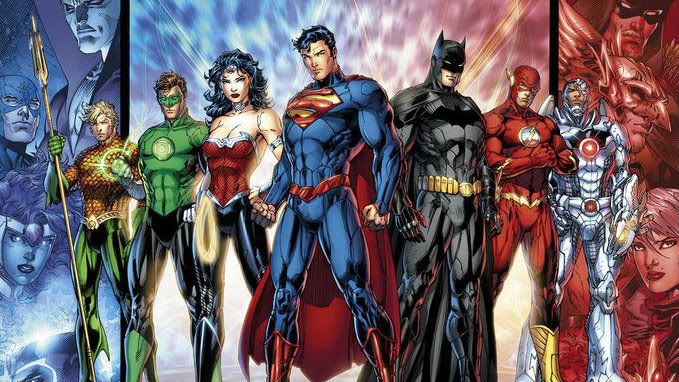
Because it's the sort of thing I think about when my wife is out of town, I was musing over the potential Justice League film that I've talked about some previously. The project is almost entirely speculation, of course, even on the part of Warner Bros. But given that they have about 1.4 billion reasons in favor, it's hard to imagine they won't give this a serious shot. And, if it's going to happen, I'd prefer WB to not rush it for the sake of money. If there's anything to be learned from what Marvel did--and what Christopher Nolan is currently doing for WB--it's that when you put time, heart, and soul into the work and focus on making the best, most entertaining film you can, the audiences will come. And when you try to just put something out there for the sake of doing it, well... WB/DC Comics already know something about that.
There was the TV pilot they did in the late '90s--you can watch the whole thing on YouTube. Seriously, see how long you can make it. It's hard to believe that this was just 3-4 years before X-Men and Spider-Man ignited the superhero movie era, after which time WB appeared ready to press their luck again, with an eventually-aborted venture titled Justice League: Mortal. Never heard of Justice League: Mortal? Lucky you.
But with Avengers steamrolling box office records, WB will gladly forget all that came before, and can hopefully learn from those missteps. Of course, there will inevitably be accusations of copycatting Marvel, but a good result can and will overwhelm those criticisms (however valid they may be). To combat the pitfalls of the kind of rank opportunism WB/DC could embrace, it needs to do a JL movie as organically as possible, with the same kind of care Marvel took, using its own formidable cast of characters (and in some ways, more formidable, the League featuring DC's finest, while Avengers left out the likes of Spider-Man and Wolverine, who were properties of other studios). Those characters just need to be established and, in some cases, re-established. So, at the risk of invoking the cruel wrath of the fan-fiction gods, here's how I would propose setting up a Justice League film (not that WB has ever asked me, regardless how many angry letters I write them):
Next year's Man of Steel is the key. Though director Zach Snyder and producer Christopher Nolan have said that this version of Superman exists on his own terms (Nolan has said similar about his Batman, but more on that later), WB won't let something as trivial as a couple of statements from the creative heads stop them--for better or worse and we're focusing on better here. Unless MOS is an out-and-out failure at the box office, it will be the first step toward the larger movie universe and that's fine; unlike Batman, any version of Superman is perfectly compatible with the League--and any JL franchise would merely inherit the tone Snyder sets in MOS. And so long as WB doesn't push Snyder to do things he's not comfortable doing, I don't predict any significant protest from him. If the studio senses good hype from the set, they could recommend something like the post-credit scene in Iron Man (which would've led to nothing if that film had flopped). A throwaway line about the discovery of an island of amazons back in the '40s, or a six-foot bat flying over Gotham is all you'd need and you can run with that later. Supes has his own problems, of course; issues of relateability and relevance in a stranger, harsher, more complex world that seems to have passed by the Big Blue Boy Scout. But that's Snyder's problem. If he can't address those issues, it's back to the drawing board and JL itself could get lost in the redrawing. But if Snyder can make the character relevant and make people want Superman again, we'll have an Iron Man effect, where a throwaway scene is seized upon and driven full speed to a new franchise, turning Henry Cavill into this universe's--this generation's--Superman.
Wonder Woman has
Green Lantern is likely out. That is, Ryan Reynolds' Green Lantern is likely out. In fact, Hal Jordan may be out altogether. But, if some of that famous Film Studio Selective Memory can be harnessed for the power of good, we might get to have our cake and eat it too. We can retain the mythology established by the Green Lantern film, because that was one of the few things the movie did reasonably well (that and Mark Strong's Sinestro, which we can also keep). But now we'll have John Stewart as the Green Lantern of Earth, a changing of the guard that can be explained in a scene or two. Stoic enough not to whine and moan about his responsibilities--as Reynolds' Jordan was wont to do--but with enough distrust of authority to give him an edge that most Lanterns lack, Stewart can deliver the intrigue and excitement of the space opera story that Green Lantern failed to give us. Depending on how much time and money WB is willing to invest, they could even give Stewart a solo movie to establish his credentials, but given the current baggage of that franchise, it might be easier to let him establish his footing in JL first. If Stewart takes off with audiences, he can even be reunited with Hal Jordan in a post-JL Green Lantern movie, hopefully with a better result.
Perhaps even more than Green Lantern, the cool-factor of The Flash's powers is easily overshadowed by how hard they are to explain without sounding stupid. For non-comics fans: he basically manipulates the laws of physics. Using that, one can do a Dr. Manhattan-esque morality play, examining the life and psychological state of a man who can move fast enough to alter history and who's own powers sometimes threaten to obliterate him. At least, that's the route I'd take. Not all characters will require a solo movie first. As with John Stewart, Barry Allen (I'm open to arguments for Wally West), may need to wait and see what kind of reaction he gets in JL. If the reaction to Avengers' Hulk (featuring a new actor in the role, as a follow-up to a movie that relatively few people saw) is any indication, there's something to be said for not forcing too many of these characters down audiences' throats. Some will need to be established on their own terms, but guys like Flash can wait for a testing-of-the-waters, so to speak. If it works, then WB's stumbled into a new franchise.
Martian Manhunter is out. I know there are J'onn J'onzz fans out there, but in a cast already full of aliens and demi-gods, a green dude in a stupid costume (even by superhero standards) with powers all-too similar to Superman's might be a bit more than WB is willing to risk. And I don't blame them (remember how well aliens worked for them in Green Lantern?). Maybe for a sequel. For now, there are other options...

Yes, Geoff Johns turned around common conceptions about Aquaman in a humorous way with the New 52 reboot. And yes, Aquaman looks great when Alex Ross draws him like this. But preaching to the fan-boy choir (made up of fans and people who want to be fans) and Alex Ross (who could paint a dry, pale booger hanging from someone's nose and it would be tempting to make a movie about said booger) aren't going to be enough to convince the everyday public that he's useful beyond the ocean and is anything other a joke who talks to fish. The Super Friends created much turmoil and its legacy remains painful to many. Those injustices will be healed in time. However, as with J'onzz, let's not bite off more than we can chew. He's out.

Green Arrow's fate will depend on the reception of his new CW show. Similar to Superman's situation in MOS, if Arrow doesn't catch on, we move on and forget all about Ollie Queen in this universe (for now). But if it does become even a Smallville-level hit, then why waste an established and moderately popular character? Of course, that's a lot of "ifs." The guy playing Queen is Stephen Amell and I'm not familiar with anyone else involved either. Not that that's a death sentence, but it's probably not best to rely on the success of someone who makes mainstream fans say: 1, "so, he's like Robin Hood?" (best case scenario), 2, "so, like Batman but not Batman?" (medium scenario) or 3, "so, like that guy in Avengers?" (worst case scenario). He's probably out.
That leaves one last best choice. When DC launched the New 52, they replaced J'onzz's role in the League with Cyborg, recently promoted from Teen Titans. Cyborg's greatest advantages tie into his weaknesses: He's not very well-known, but he also doesn't come with the baggage that some of these characters do; he's almost a clean slate with which a writer/director could create banal crap, but could also write a new classic character. Cyborg would also be a good in for the audience. In a cast of gods and aliens, a relateable character--like a teenage-kid that's suffered a traumatic accident and come out of it a superhero--is a necessary and easily forgettable element. Add to that what could be a unique look (there a thousand places this translation to screen could go wrong, but that caveat that applies to every paragraph in this post) and the League may have the grounding it often desperately needs. Yes, grounding, from a character named "Cyborg"--moving on.

What's that? You say I've forgotten Batman? Well, I haven't. And fuck you for assuming I ever would. The League needs Batman, both for in-story reasons (Bruce Wayne's finances, Batman's coordination skills) and to draw interest (people kinda like Batman). However, he's sometimes had trouble proving that he fits into the League. And Nolan's films haven't helped that image with their "de-powered" Dark Knight. Someone who has that much trouble defeating Joker (and being forced to tarnish a part of himself in the process) probably shouldn't be going into battle against Darkseid. But Nolan's franchise will be done after this summer, at which point WB will start anew. And I have to think that they will do it with an eye toward JL. While my reasoning on this will require a blog post unto itself (which I may well do after The Dark Knight Rises), I count this is as a good thing. Nolan has given us a better series of films than Batman fans ever had a right to hope for. Let's leave them be and try something different. We survived Batman & Robin--we can survive anything. Start the new franchise with Batman well-established in Gotham and confronting a slightly more fantastical plot (think the old Animated Series, which meshed gritty street drama with more than a few outlandish elements). Suddenly it doesn't look quite so funny when Superman appears, floating above one of Batman's rooftop brooding sessions. And with Batman League-ready, the sequel writes itself with a Tower of Babel story, demonstrating why he belongs in the group (albeit in the scariest way possible).
But I'm getting ahead of myself. There's still the join-up story to consider...
Another time.
Subscribe to:
Posts (Atom)